Understanding Angles: Acute, Obtuse, and Right
Whenever two straight lines or rays meet at a shared point called a vertex, they form an angle. Angles are fundamental to architecture, navigation, carpentry, graphic design, and physics. Whether you are framing a doorway, aligning roof trusses, or aiming a telescope, knowing how angles are measured and categorized is essential. When you are calculating complex trigonometric angles or working out geometric proofs, an online calc solver keeps your degrees and radians perfectly accurate.
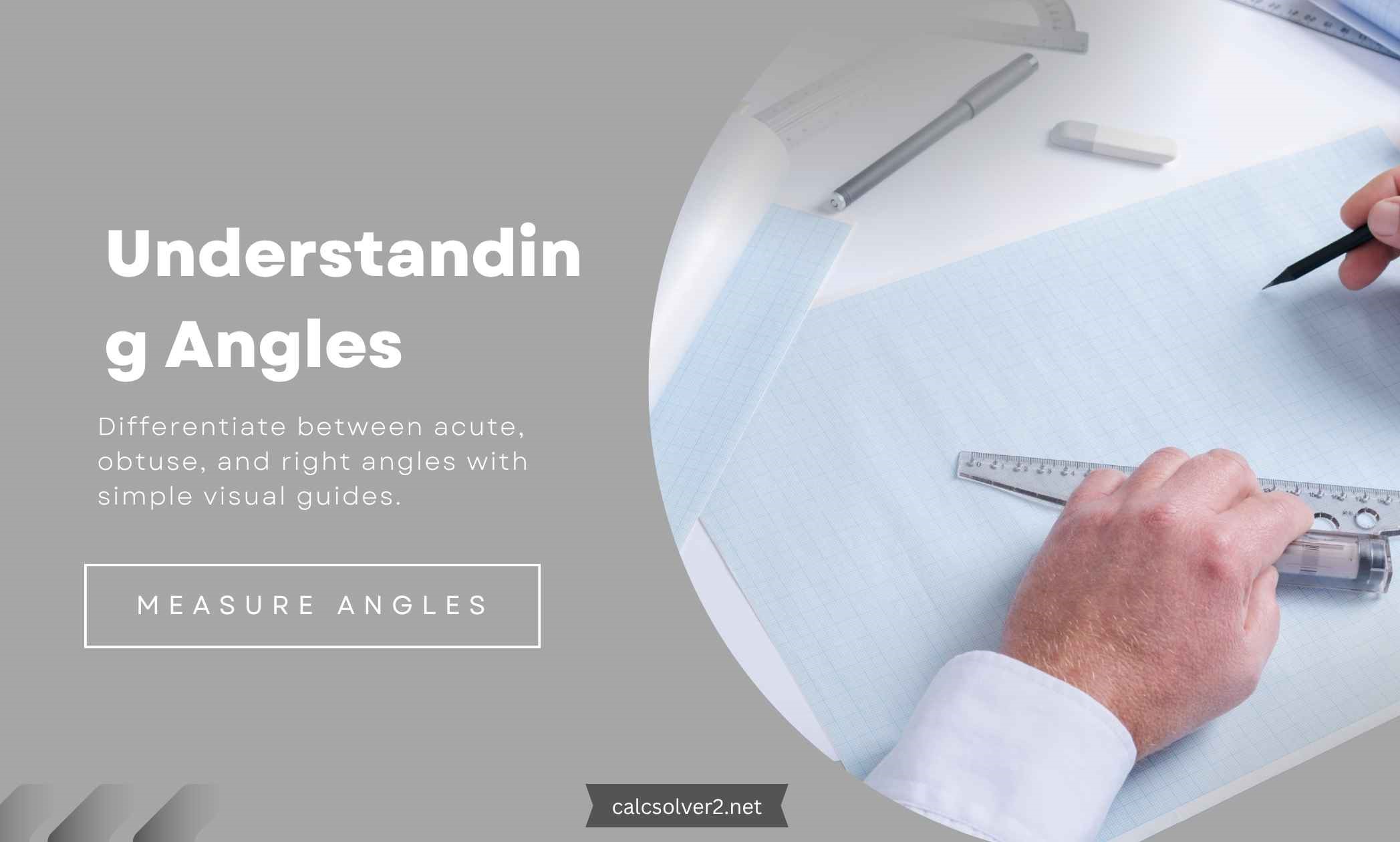
Angles are measured in degrees, symbolized by a small raised circle. A complete full rotation around a single central point measures 360 degrees. Based on where an angle falls between 0 and 360 degrees, it is classified into distinct geometric categories.
The Four Primary Angle Classifications
Geometry defines four fundamental angle types that appear throughout daily problem solving:
- Right Angle: Exactly 90 degrees. Formed by two perpendicular lines, resembling the corner of a square or a sheet of printer paper. Denoted with a small square box in diagrams.
- Acute Angle: Greater than 0 degrees but strictly less than 90 degrees. These angles are sharp and narrow, resembling a slice of pizza or an open pair of scissors.
- Obtuse Angle: Greater than 90 degrees but strictly less than 180 degrees. These angles are wide and open, like a reclined lawn chair or an open book.
- Straight Angle: Exactly 180 degrees. The two rays point in completely opposite directions, creating a flat, continuous straight line.
Reflex and Full Rotation Angles
While most classroom geometry focuses on angles up to 180 degrees, angles can continue opening past a straight line:
Also read: Different Types of Triangles Explained Clearly
You may also like: Pythagorean Theorem and Right Triangle Problems
A reflex angle measures greater than 180 degrees but less than 360 degrees. If you open a folding fan past a straight line, the exterior angle formed is a reflex angle.
A full angle, or complete rotation, measures exactly 360 degrees. The hands of a clock complete a 360-degree rotation every twelve hours.
| Angle Type | Degree Range | Visual Characteristics | Everyday Example | Key Geometric Property |
|---|---|---|---|---|
| Acute | 0 to 89 degrees | Sharp, narrow opening | Clock hands at 2:00 (60 deg) | All angles in equilateral triangle |
| Right | Exactly 90 degrees | Perpendicular corner | Clock hands at 3:00 | Corner of walls, paper, frames |
| Obtuse | 91 to 179 degrees | Wide, blunt opening | Clock hands at 5:00 (150 deg) | Cannot exceed one in a triangle |
| Straight | Exactly 180 degrees | Continuous flat line | Clock hands at 6:00 | Sum of angles in any triangle |
| Reflex | 181 to 359 degrees | Exterior wraparound | Outer corner of house bend | 360 minus interior angle |
Special Angle Pairs Complementary and Supplementary
When two angles share a boundary or combine together, their sums reveal special mathematical relationships:
- Complementary Angles: Two angles whose measures add up to exactly 90 degrees. For example, 35 degrees and 55 degrees are complementary. In every right triangle, the two acute angles are always complementary.
- Supplementary Angles: Two angles whose measures add up to exactly 180 degrees. When a straight line is divided by an intersecting ray, the two adjacent angles are supplementary. For instance, 110 degrees and 70 degrees are supplementary.
- Vertical Angles: When two straight lines cross, the angles opposite each other at the intersection point are called vertical angles, and their degree measures are always completely equal.
Angles in Practical Carpentry and Construction
Carpenters use angles every day when framing houses and cutting crown molding. Roof rafters are cut at precise acute angles (known as the roof pitch) so rainwater sheds smoothly.
If a roof truss has a pitch angle of 30 degrees with the horizontal ceiling joist, the angle formed at the peak must be supplementary with the other side to create a stable, symmetrical structure. Similarly, miter saws in finish carpentry are calibrated to exact 45-degree angles so that two cut boards join together to create a flush 90-degree right corner for window casings and door trim.
Measuring Angles with Digital Inclinometers and Apps
In modern woodworking and mechanical engineering, smartphones and digital angle finders (inclinometers) provide instant degree readings down to the tenth of a degree. Placing a digital level across a staircase stringer or saw blade confirms whether an acute or right angle meets building code specifications without manual protractor alignment.
Common Mistakes in Angle Identification
Avoid these frequent misconceptions when working with angles:
- Thinking longer arm lines mean a larger angle: The size of an angle depends solely on the degree of rotation between the rays, not the drawn length of the lines.
- Misreading protractors: Standard protractors feature two scales (inner and outer). Always verify whether your angle starts from the left zero line or right zero line before reading degrees.
- Calling 90 degrees acute or obtuse: 90 degrees is strictly a right angle. It does not belong to either acute or obtuse classifications.
Understanding these angle categories helps you navigate geometry, design plans, and spatial measurements with complete accuracy.