How to Find the Surface Area of a Box Easily
From gift wrapping and shipping packages to painting rooms and manufacturing cardboard cartons, calculating the surface area of a box is an essential practical skill. While volume measures how much stuff fits inside a box, surface area measures the total exterior covering needed to wrap around the entire outside. If you are calculating material costs for packaging or shipping projects, an online CalcSolver delivers instant surface area totals without math errors.
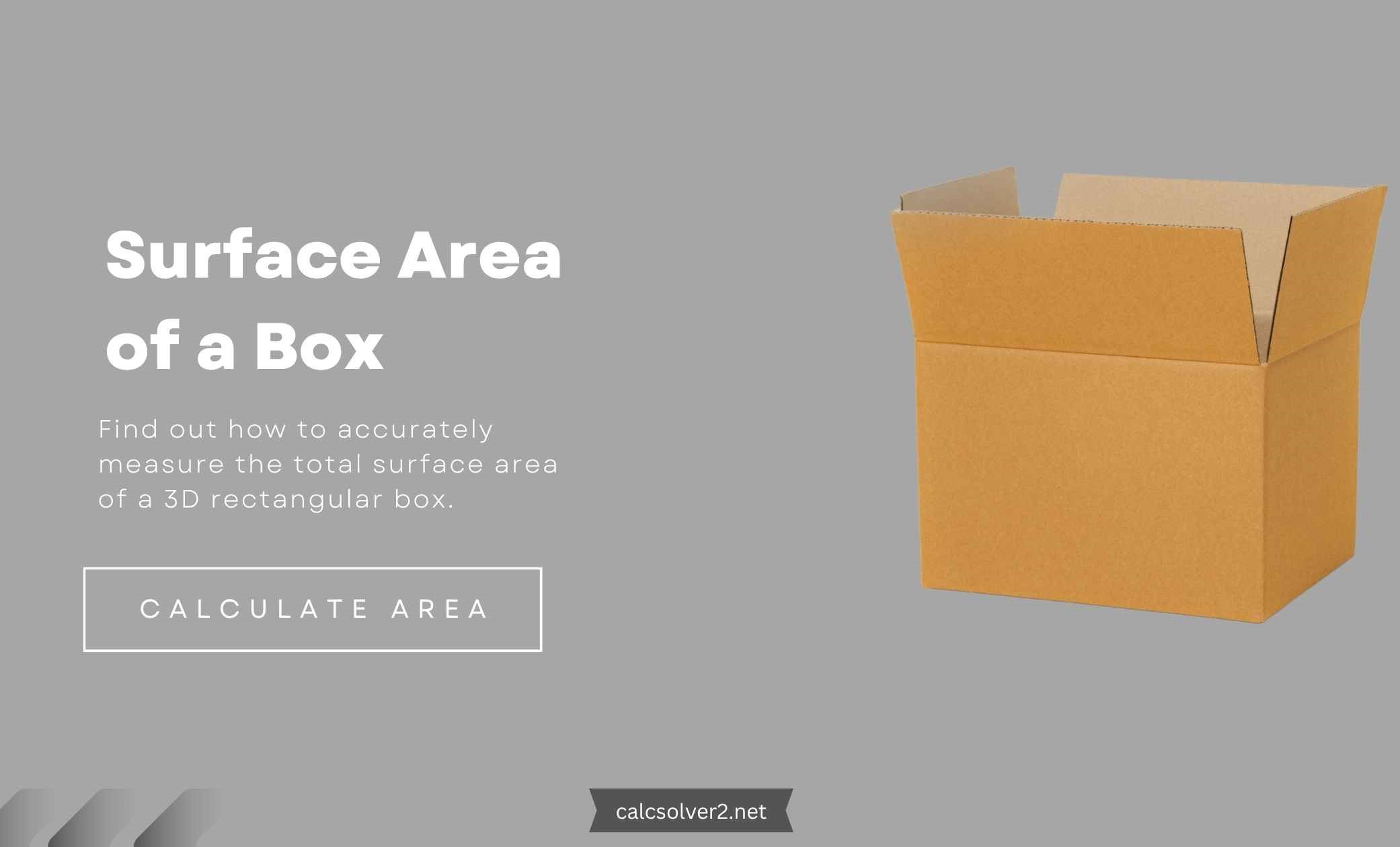
In geometry, a standard cardboard box is called a rectangular prism or rectangular cuboid. It has six flat rectangular faces organized into three identical pairs: front and back, top and bottom, and left and right sides.
The Rectangular Box Surface Area Formula
To find the total surface area of a box, you calculate the area of all six faces and add them together. Because opposite faces are completely identical, the formula is:
Surface Area = 2 x (lw + lh + wh)
Where the three dimensions represent:
- l is the Length of the box.
- w is the Width of the box.
- h is the Height of the box.
The three internal products represent the three unique face pairs:
- lw is the area of the top and bottom faces.
- lh is the area of the front and back faces.
- wh is the area of the left and right side faces.
Suppose you have a shipping box that is 10 inches long, 6 inches wide, and 4 inches high. First, calculate the three individual face areas: 10 x 6 = 60; 10 x 4 = 40; and 6 x 4 = 24. Next, add these three areas together: 60 + 40 + 24 = 124 square inches. Finally, multiply by 2 to account for both sides of each pair: 124 x 2 = 248 square inches. The total surface area is 248 square inches.
Visualizing the Box Net
If you have ever flattened an empty cardboard shipping box for recycling, you have seen a geometric net.
Also read: Finding the Volume of a Cylinder with Ease
You may also like: Area and Volume Solver for Common Shapes
A net is the unfolded, two-dimensional layout of all six faces laid flat on a table. Thinking of a box as an unfolded net makes surface area intuitive: you are simply summing the areas of six connected rectangles.
| Box Face Pair | Dimensions Used | Sample Dimensions (12 x 8 x 5 cm) | Single Face Area | Combined Pair Area (x 2) |
|---|---|---|---|---|
| Top and Bottom | Length x Width | 12 cm x 8 cm | 96 cm^2 | 192 cm^2 |
| Front and Back | Length x Height | 12 cm x 5 cm | 60 cm^2 | 120 cm^2 |
| Left and Right Sides | Width x Height | 8 cm x 5 cm | 40 cm^2 | 80 cm^2 |
| Total Surface Area | Sum of all 6 faces | All pairs combined | 196 cm^2 (half) | 392 cm^2 (Total) |
Practical Gift Wrapping and Packaging Material Calculations
When wrapping a gift box with wrapping paper, calculating surface area gives you the absolute bare minimum paper required. In reality, wrapping a physical box requires extra paper for overlapping seams and folding side flaps.
A good rule of thumb in package design and gift wrapping is to add 15 to 20 percent to the calculated surface area to accommodate overlapping seams and tape edges. If your gift box has a total surface area of 392 square centimeters, adding 20 percent means you will need approximately 470 square centimeters of paper roll to wrap the package neatly. Understanding surface area prevents running out of wrapping paper midway through packaging.
Surface Area of a Perfect Cube
A cube is a special case of a rectangular box where all three dimensions are completely identical: length equals width equals height (l = w = h = s). Because all six faces are identical squares of area s^2, the formula simplifies dramatically:
Cube Surface Area = 6 x s^2
For a cubic storage container with side length 5 feet: 5 squared is 25 square feet. Multiplying by 6 faces yields a surface area of exactly 150 square feet.
Handling Open Top Boxes
In many real-world problems, such as lining an open fish tank or painting an open storage bin, the box has no lid. An open-top box has only five faces instead of six. In this case, you calculate only one top/bottom face instead of two: Surface Area = lw + 2lh + 2wh.
Common Mistakes to Avoid
Watch out for these frequent calculation errors:
- Multiplying length, width, and height together: Doing l x w x h calculates volume (cubic capacity), not surface area. Remember that surface area requires adding face products together.
- Forgetting to multiply each face pair by two: A common oversight is calculating lw + lh + wh and stopping, which covers only three of the six faces.
- Using mixed linear units: Ensure all three dimensions are converted to the same unit before multiplying.
Following this simple pairwise formula ensures you will calculate the surface area of any box quickly and accurately.