Blog

  • How to Solve Word Problems Using Algebra Successfully

    Many students who excel at solving numerical equations freeze when presented with a math word problem. Paragraphs filled with story details, names, and mixed numbers can feel overwhelming. Yet in the real world, mathematics never arrives as a tidy equation written on a chalkboard. Real engineering challenges, business investments, and daily logistics always begin as…


  • The FOIL Method for Multiplying Binomials Simply

    Multiplying two binomial expressions together is one of the most frequently tested procedures in high school algebra. Whether you are finding the area of an expanding rectangular patio or expanding quadratic factors, you need an organized way to ensure every term in the first parenthesis multiplies every term in the second parenthesis. The FOIL method…

  • Simplifying Algebraic Expressions Step by Step

    Long algebraic expressions filled with parentheses, negative signs, and multiple variables can look messy and complicated. In mathematics, an expression is simplified when it is rewritten in the cleanest, most compact form possible without altering its mathematical value. Simplifying expressions is a required prerequisite before you can solve equations, factor polynomials, or evaluate functions. When…

  • How to Graph a Linear Equation on a Grid

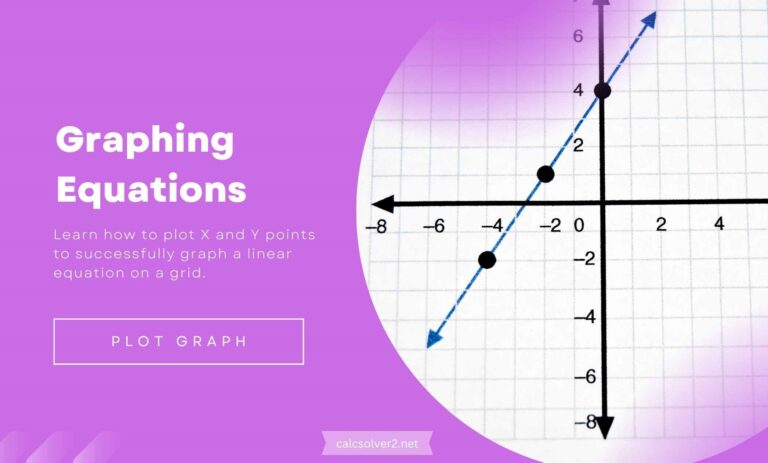
    A linear equation creates a visual bridge between algebra and geometry. While looking at an equation like y = 2x – 3 gives you numerical rules, drawing that equation on a coordinate grid transforms abstract symbols into a clear, continuous line that reveals patterns at a glance. Graphing linear equations is essential for interpreting trends…

  • Understanding Variables and Constants in Algebra

    Moving from basic arithmetic into algebra is often the moment students feel math shifts from concrete numbers to abstract letters. In arithmetic, every symbol represents a fixed value: 5 is always five, and 12 is always twelve. In algebra, symbols like x, y, and n appear alongside numbers. Understanding the vital difference between variables and…

  • How to Solve Quadratic Equations Simply

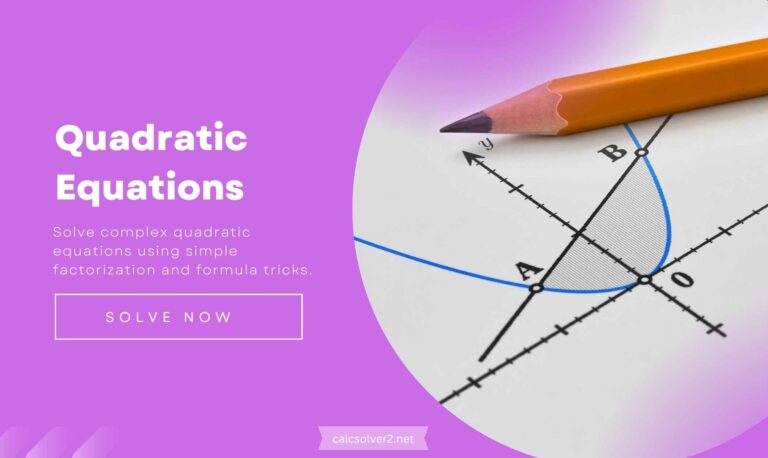
    Quadratic equations are one of the cornerstones of high school algebra and physics. Whether you are calculating the flight trajectory of a baseball, finding maximum profit in a business model, or designing parabolic architectural arches, quadratic equations describe curved, nonlinear relationships. While solving them by hand can feel complex when roots are irrational, a dependable…

  • Different Types of Triangles Explained Clearly

    Triangles are the most rigid and stable structural polygons in geometry. From suspension bridges and construction cranes to roof trusses and bicycle frames, engineers rely on triangles because their shapes cannot deform without physically bending one of their sides. In mathematics, classifying triangles correctly is the foundation for trigonometry, coordinate geometry, and architectural drafting. When…

  • How to Find the Surface Area of a Box Easily

    From gift wrapping and shipping packages to painting rooms and manufacturing cardboard cartons, calculating the surface area of a box is an essential practical skill. While volume measures how much stuff fits inside a box, surface area measures the total exterior covering needed to wrap around the entire outside. If you are calculating material costs…

  • How to Convert Centimeters to Inches Accurately

    In our interconnected global world, measuring units can differ depending on where a product is designed or sold. Most countries use the metric system (centimeters and meters), while the United States relies heavily on the imperial system (inches and feet). Whether you are buying clothes online, checking screen sizes for televisions, buying tools, or reading…

  • Understanding Angles: Acute, Obtuse, and Right

    Whenever two straight lines or rays meet at a shared point called a vertex, they form an angle. Angles are fundamental to architecture, navigation, carpentry, graphic design, and physics. Whether you are framing a doorway, aligning roof trusses, or aiming a telescope, knowing how angles are measured and categorized is essential. When you are calculating…

  • Finding the Volume of a Cylinder with Ease

    From aluminum beverage cans and soup containers to grain silos and water storage tanks, cylinders are one of the most practical three-dimensional shapes in packaging and engineering. A cylinder consists of two parallel circular bases of identical size connected by a curved lateral surface. Finding the volume of a cylinder tells you exactly how much…

  • How to Calculate the Area of a Circle Simply

    Circles are everywhere in our everyday surroundings, from dinner plates and circular garden beds to round tables and car tires. While finding the area of a square or rectangle is as simple as multiplying length by width, calculating the surface area of a curved circular shape requires working with one of mathematics’ most famous constants:…